


NEON - WHO ARE THEY?
Neon is a company set up by artist and thinker Deepa Mann-Kler. It is based around the development of the immersive realities such as VR and AR, and have had different projects developing applications for various well-being and medical experiences. However, the company is looking to broaden its space into a more narrative driven experiences. Upon meeting with the client, she has left us pretty open to do whatever we see fit, and has encouraged us to develop something with a bit of a more narrative placed approach.
Initial Thoughts
After the meeting, we set off for the weekend. By Monday, we are to have formed some idea's to debate over what we are going to be working on. I already have a narrative idea with regards to a 360 video, being a brainchild of a brief from last term. It makes sense to me to think of three idea's for Monday. One a 360 video, a VR experience (i.e a game) then a AR experience.
360 VIDEO
In terms of what this course is all about, a 360 video would be the most approachable from what we have learned so far. We would be using skillsets which we are all used too, and from a technical perspective, we would be able to fit a lot more detail into our models. Nuke, the compositing programe I'm learning at the moment, also has plug ins for compositing in 360 video, which would be great if I was able to get that fitted in there.
From a creative perspective, you really need to play into the medium in which viewers are going to perceive your work whenever you are developing this. Often 360 videos which I have seen so far, they are very similar to the likes of a ride or a roller coaster. Everything is on a track and the narrative unfolds via what is happening around you. From a personal perspective, I quite like the idea of being immersed with the machine (i.e something like the matrix). I think it pairs quite fitting with the medium of actually wearing the goggles or something on your head.
- Some thoughts-
Underworld Idea: You are taken on a journey to the underworld, but whenever you get there, the administration realised that you have gotten yourself into a mix up, and you aren't actually meant to be dead. You befriend one of the lost souls, and you go on a colourful adventure back to the surface world.
Stylistic Reference:- Mexican day of the dead, adventure game Grim Fandango
Tuam Idea: The most developed Idea which I've had for a 360 video, however, it was shot down in the previous group because it was too "edgy". Based around the revelations which were made in 2014, about the Catholic church's mistreatment of children and the discovery of a mass grave of over 700 bodies of kids aged from infancy to early teens, the idea takes the viewer through different environments highlighting the story of a child who made it through the Bon Secours Mother and Baby Home.
Stylistic Reference: Silent Hill, PT, Little Nightmares, surrealist and post impressionism.
FIRST GROUP MEETING
Having the weekend to discus our ideas, coming talk today left us no more in the know. Everyone had come up with some really cool ideas.
Some of the stuff I particularly liked:
AR - Ulster Museum idea, Anxiety tidy up, personal planner.
VR - Underwater concept,
Overall I don't really mind what direction we decide to take it. I'm pretty excited overall with where we are going to take this.
Concepts and Story suggestions
Talking to other group members during the week, it seemed that everyone was centred around the idea of doing a VR idea underwater. Drew up some environment and character concepts to present with the idea.


WEEK 3
With the 3rd meeting finished, we have a clear idea of what direction we are going in with terms of story. Deepa really loved everything we had came up with. With production schedules underway, its only a matter of bashing out the work and getting things put together now.
The items which I have been placed on are
- the scientists crashed submarine
- The seal "friend" in which the character comes across
- The "aqua jet" item which they pick up further the story process
- Various story items in which the character pics up, such as the "obituary" and and the photo frame.
Other challenges I want to look into -
Developing the style to get a toon-shader to work in unity
Technical difficulties with getting our stuff into a unity render.
Misc Concepts


FIRST MODELS
After consolidating our idea, we each picked a character to model. I got the seal.
The other assets I have to do are:
- The Obituary
- The Eco Jet
- The Schematics
- Other environmental stuff we are working on


.jpg)
Toon Shader Research
Since AR and VR require simple models and meshes to be able to run, we are going to need to wow people with a solid story and then a solid style.
.png)
Some work I've found on reddit. Full VR in unity. Dragging through some of the comments, he gives some insight into how to make it
"A little background info: For this the models were created with oculus medium, a vr sculpting program. Rendered in Unity3d and the shader I used is from the amplify shader asset. It has a toonshader example which I modified a bit to read vertex colors instead of textures. I might do a small videotutorial if I get around to it."
Looking into YouTube for other sources on toon shaders. Theres a whole shader section in unity which I didn't know about, so instead of using substance it could be best just to bring it in all together.
https://www.youtube.com/watch?v=T8TCW7Vlh58&t=169s
Environment Tests
Taking a break from the character, I decided to go ahead and work on some environmental assets from the list above. However, looking back on this, was still focusing my eye towards something which has more cinematic value instead of a design based plan for something in which a player can navigate around. It seems that game design is much more about practical thinking rather than creativity. However, I think that these renders still have a good mood and atmosphere to them.

.png)
.png)

For the ground and rocks, I used a material I had previously created in substance designer. I changed it around a bit with different hue/tone adjustments in Painter, then layering a couple of different normal maps on top of it. It is also a great reason to build up a shader and material library.
Updates and critique on the character:
Bringing my work up at the meeting that week, I was told that If I was designing a character for kids then there would need to be more of a focus towards its eyes, to make it more relatable. However, since this was a video game, It would still need to be kept relatively low poly. Making the eyes as textures was a consideration, It would also make the rigging of the character a lot easier. However, I like the feel that actual geometry has for character development. Textures would be hard to get working at multiple angles aswell.


With going forwards, I would defiantly UV stuff as I go along. I think that I could have done a bit more with the silhouette of the character, along with utilising z brush more to get a more fluid style to it. However, I am happy how it turned out. A rig will still need done, however.
AUXILIARY ASSETS
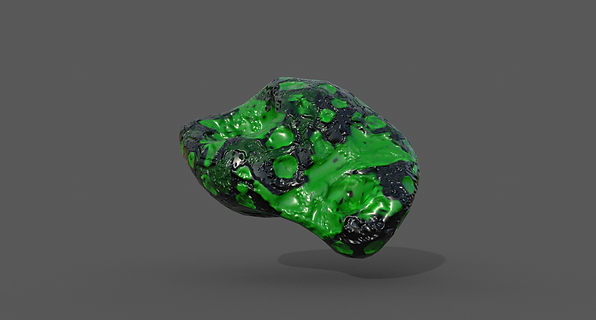
Some assets used to populate the scene. Was finding this hard, but whenever I started to pick up Zbrush then I realised that making different pieces like coral and rocks became a lot more fun. Designing the coral in zbrush was cool.
NATURAL


.png)
.png)
.png)
.png)
MECHANICAL
.png)
.png)
.png)
.png)
.png)
.png)
TEXTURING
Texturing and designing the submarine and mechanical items for the scene was a fun part of the process. All the assets needed to look aged and eroded by water. The same rules needed to apply to the models, so texture maps where kept at 515x512 resolution, and only made up of a couple of layers.
For the coral, I wanted to do a couple of different versions, a set which where alive, and a set which where dead, in theme with the environmentalist thing we are trying to work in. When coming to the Submarine, I realised once I finished the main body that it would be cool to have a bunch of exterior objects around the scene, to make it seem like it had crashed and parts fell off. However, Substance is particularly bad for the transfer of different texture sets to other assets. However, converting it to a smart material seems to be the way around it. It sped up the process quite a bit.
It's a shame I had to bake down a lot of the details of the sculpt, but they are still pretty cool and are great assets to stick into the library.
Scene map:
UNITY
Our next task was to now place everything together in one scene file. We set up a project on one computer, bringing in multiple different elements for the scene one by one. I found this stage of the project very tedious, and took a lot of trail and era to get a satisfactory solution to regards of how everything looked, and worked, within the game engine. Personally, I think that using Unreal for the project would have been more beneficial at this stage, but it is a resource which I intend to investigate for another personal project.
I tried looking into a toon shader but tried with an ineffective result. The shader graph in Unity is quite hard to get around and to someone who has only started the programme it was quite tough. I managed to get a hold of a screencap of a guy who had recreated the Breath of the Wild art style but whenever trying to break it down I found it incomprehensible. Good for future reference however.
I tried looking into basic Unity look development tools, and found out that there was a way to induce a moving texture mechanic.
.png)
.png)
Figuring out how to blend two normal maps on top of each other for making the illusion of some slowly flowing water. It took quite a while to get working but satisfactory to use. However, since our entire thing would be underwater we wouldn't be seeing the surface. Unless I can find a way to flip it and have the underside, getting the transparancy for the light correct will still be hard.
Tiling became a bit of an issue for some assets. Looking into this, I learned that there are different methods used by game designers to come across this. A big difficulty is achieving a large level of detail on a real time basis, to take away from the low resolution geometry which is needed. Normal maps are one of the keys forward on this. Also, I looked into the use of Decals as a tool texture artists use to fake detail. They are basically a spray on patch which is basically the spray tag feature that you can find in many online video games.
Talking to a placement student one day, he talked to me about the use of a technique called Trimming used by big game studios for large scale environments. Found an article explaining it:
https://www.gdcvault.com/play/1022324/The-Ultimate-Trim-Texturing-Techniques]
Essentially, the technique is taking different details and adding them onto a tillable UV. With this, they can be applied to any surface as a normal maps. The ins and outs of it I haven't quite understood yet, but it is a fascinating way to work around different problems when it comes to texturing. Will defiantly be investigating further.
As for who did what at this stage, It was kinda a free-for-all. We just set up the Project on a uni computer and let anyone add stuff whenever. Not the most ideal situation, but I still feel what we pulled together turned out well.
SCENE BUILD

IN UNITY


CONCLUSION
For the most part, this group was fun to work with.
Through the pre-production planning, we all gelled really well together and had a great time feeding off each-others ideas. The downfall came later. A combination taking too long to start, and the learning curve of only two people on the team knowing how to use Unity, it took a while of getting used to that and in the swing of a new pipeline. I think that a bit more direction from the company would have helped in the aforementioned areas, but overall the company where still great.
My initial reaction to, "do whatever you want!" was fantastic. But because of this, we maybe set the task at an impossibly high standard. It was a great learning curve, which in the end is what doing this degree was about, but I am somewhat disappointing in myself, and the outcome of the project. Compared to what the initial planning and ideas consisted off, it could have went in so many ways. The disappointment in myself comes from spreading myself too thin. With the amount of work which needs put in to a project at this stage of the game, especially with the lurking placement which is to follow, needs to be the equivalent of a full time job.
The main pro I can take from this experience is the fact that I have now worked with a game engine. We still need to get the scene working with VR, but this is something to improve on in the future. I also had good practice at sticking to a poly count, as well as developing more skills as a Look Dev and environment artist. I also picked up Z Brush from this project, which is something that I have really grown an interest in, as well as Substance Designer.
However, I feel that although I still love games, I am finding game engines somewhat annoying to work with. There are certain things which just don't make sense for me coming from Maya. Perhaps I need more practice. Would like to try something in Unreal the next time around, or possibly for an environment I am making up in the background.
I am not sure what the company's potential use for our work is. I hope to see something cool made from it at some stage.